
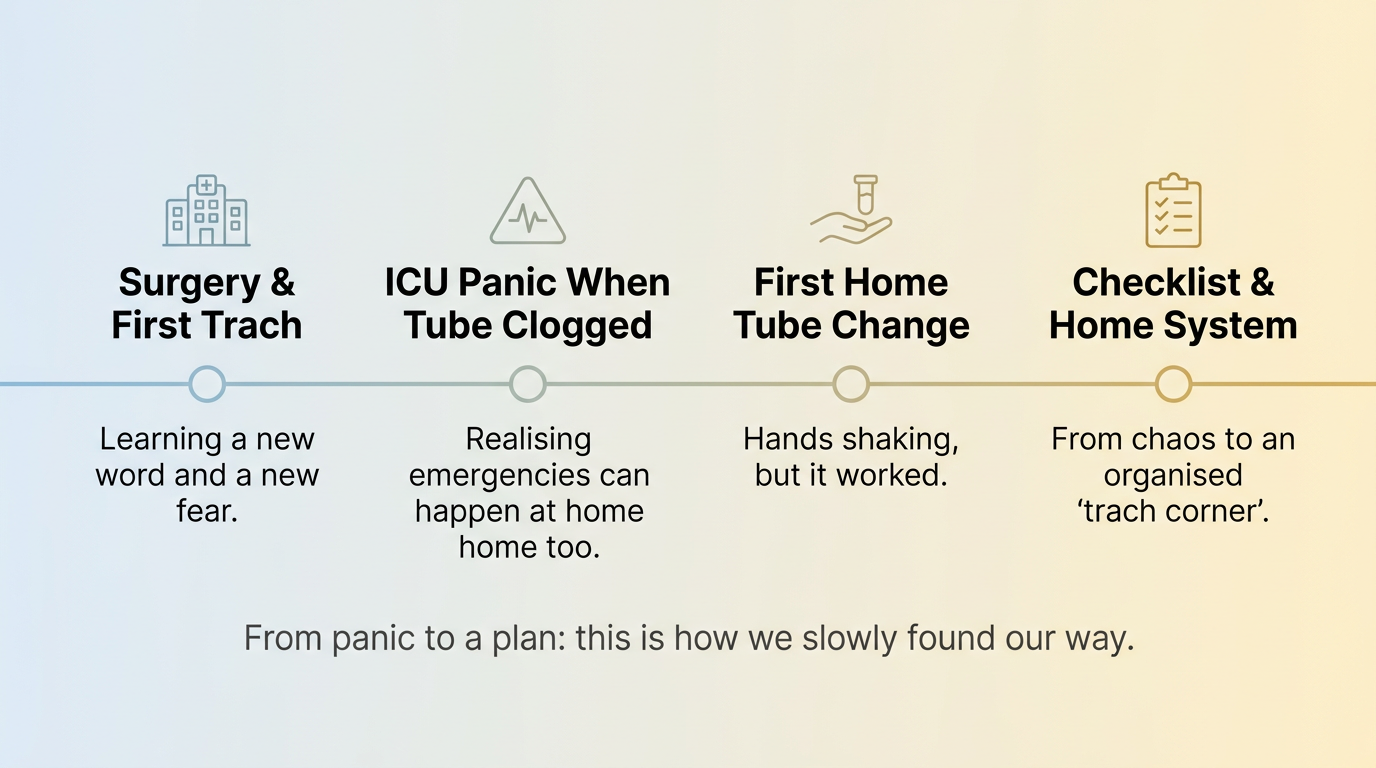
By the time “tracheostomy” entered our vocabulary, cancer was in my father’s breath, not just his reports. The trach, we were told, would help him breathe and clear secretions. What no one really says is that a tracheostomy doesn’t just change a neck; it changes a household – the sounds in the room, how you sleep, and what you’re afraid of.
This isn’t a medical manual. It’s what it felt like to live with that hole in his neck – and a few practical things I wish someone had told me, the sort you don’t find in discharge summaries.
To trach or not to trach
Sometimes a trach is presented as non‑negotiable. Sometimes it’s offered as an option. Both are terrifying.
After my father’s ordeal, a close friend called. Her father’s doctors were recommending a tracheostomy. She asked what I thought. I told her how hard it had been for my dad – the constant suctioning, the choking, the fear in his eyes when mucus plugged the tube. If there was a safe way to avoid it, I would, I said.
She chose to go ahead anyway. She, understandably, didn’t want to live with the thought that she had refused a potentially life‑saving step. Later, after her father passed away, she told me she wished she had listened to me. She had endured the same endless suctioning and struggle that I had.
But here’s the uncomfortable truth that I still believe: either choice comes with regret potential. Saying yes can mean watching them suffer; saying no can mean wondering if you shortened their time. There is no easy, universally “right” answer to the trach question. There is only the decision you can live with, in that particular medical context, with that particular person.
What you can do is ask your doctors very specific questions:
- “Is this trach absolutely necessary, or is it one option among many?”
- “What will his day‑to‑day look like with a trach at home?”
- “Who will handle suctioning and tube changes after discharge?”
Then you choose the option you can live with, not the one that sounds good to strangers on the internet.
The day the tube clogged
After surgery, the doctor showed me how to care for the trach and even how to change the tube. I nodded as if I would, then went home determined that I would never actually do it.
So I didn’t.
We did suctioning and dressing changes. We avoided the one thing that truly scared me: changing the tube. The first time it clogged and he started choking, we rushed him to the ICU. They bagged him with an ambu bag, cleared the passage, stabilised him. He thought he was dying. I almost believed it too.
The second time it clogged, the same panic arrived, but now it came with a horrible realisation: we could not rely on emergency rooms every time. Like it or not, I was the trach person in this house.
So I finally did what I’d been avoiding. I laid out the tray, silently chanted HIS Name, and changed the tube myself. My hands shook. I was sure I would hurt my father. But it went in. He could breathe easily again. It worked.
I also didn’t know it was the first of many, many tube changes to come.

The not‑so‑sterile reality of home trach care
Doing trach care “by the book” at home is expensive. We couldn’t afford a brand‑new tube every 10–12 days. So we rotated 2–3 tubes.
My mother became our home head of sterilization. She would stand at the sink, painstakingly clean dried mucus from each tube (yes, it looked exactly like those cigarette‑pack photos), then boil the tubes thoroughly, dry and wrap them in aluminium foil for reuse. We bought gloves and sterile suction catheters directly from a distributor to cut costs and tried to use a fresh catheter each time.
Inserting the tube was its own education. In the beginning, not knowing better, I sometimes tried to push through resistance. More than once, blood suddenly shot out of his tracheostomy like a little fountain and hit the opposite wall. Seven feet away. As high as up to the ceiling. It was as horrifying as it sounds.
When I struggled to insert the tube and his breathing worsened, I later learned that I can slide a fresh suction catheter directly into the opening just so air could pass for a minute. That tiny hack bought us time to breathe – both of us – before trying again.
Practical things that helped with the trach tube change:
- Slip in a fresh suction catheter in the trach opening if inserting the tube takes time.
- Insert the tube as the patient inhales, it almost always goes in more smoothly.
- Always keep a smaller‑size tube at home as backup – this may be required as the opening narrows over time, and the regular one does not go in. But I’d consider this the very last resort since you cannot go back to a bigger sized tube and you end up narrowing the area air can pass through.
These are small, unglamorous tricks. But they turned repeated emergencies into difficult, manageable tasks.
Backups, human and otherwise
If your loved one has a trach and you can afford a nurse, insist on someone who has actually handled trach patients before – not just someone who has “seen it once.” Ask, “Have you done emergency changes? Can you show me how?”
But even with good nurses, don’t outsource all the knowledge. Learn suctioning. Learn tube changes. Teach at least one other family member. Not because you want to be heroic, but because trach crises don’t always respect shift timings.
There was a day I got a call at work: “He’s choking again.” I left the office, raced home through traffic, changed the tube, checked he was stable, and went back to work. On paper, that sounds dramatic. At the time, it was simply… Tuesday.
What it did to him, and to us
For my father, the trach was a constant reminder that things were serious. It stopped his speech and altered his comfort, his sleep, his sense of dignity. For my mother, it meant endless cleaning, boiling, wrapping, watching. For me, it meant breathing became something I listened to, all the time, even in the next room.
And yet, by my Guru’s Grace, I stopped running from the tube and learned to work with it. The fear never fully left, but competence grew around it like scar tissue.
If you’re in the middle of this right now, here’s what I wish someone had whispered in my ear at the hospital:
- You are allowed to question the trach – and still say yes to it.
- You are allowed to be terrified of touching it – and still learn to change it.
- You are allowed to hate what it puts your loved one through – and still clean, suction and protect it like something sacred.
In our case, the tracheostomy didn’t save my father’s life. Cancer was already too far ahead. But it did give us more time with him at home, and it forced me to grow into a version of “the adult in the room” I didn’t know I could be.
If your parent now breathes through a hole in their neck, you didn’t sign up for this — but you are more capable than you feel. The first time will be terrifying. The second time will still be hard. And one day, you may catch yourself changing a tube in the middle of a Tuesday and realise: you didn’t just keep them breathing; you learned to breathe through this too.
Leave a Reply